+86 183 3953 1958
中文
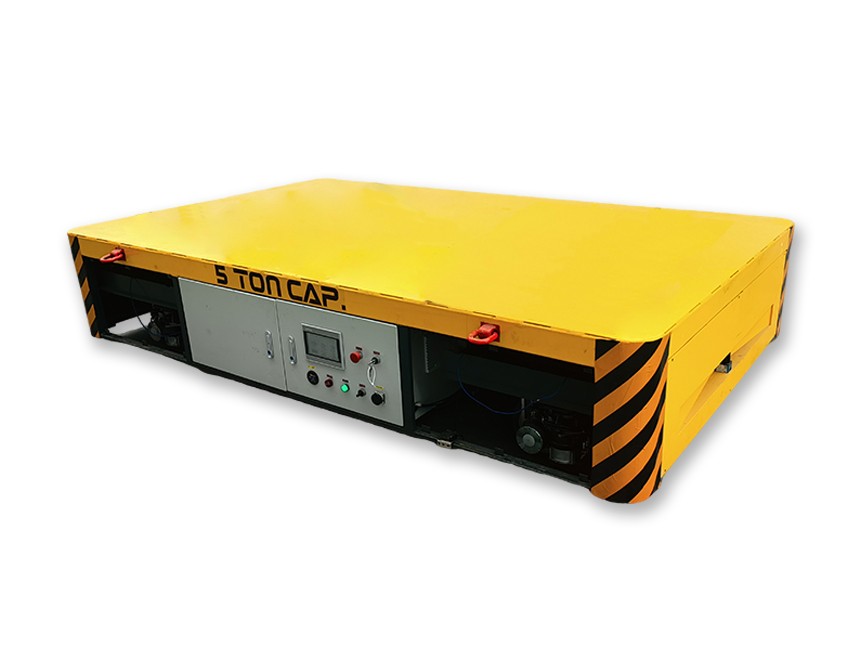
When specifying an electric transfer cart, the most consequential decision isn't the load capacity or deck dimensions—it's the power delivery system. Battery-powered and cable-powered carts look similar at a glance, but they impose fundamentally different constraints on how, where, and how long the cart can operate. Choosing the wrong power system for your application means either paying for battery capacity you don't need or living with cable-management headaches that slow every transport cycle.
This comparison covers the practical differences between the two systems across the dimensions that affect daily operations.
A battery-powered cart carries its energy source on board, typically in a compartment beneath the deck or in a dedicated enclosure at one end. The battery feeds a motor controller that drives one or more electric motors connected to the wheels. There is no physical connection to the facility's electrical infrastructure during operation. When the battery depletes—typically after 4–8 hours of continuous operation depending on load and duty cycle—the cart must be parked at a charging station. Modern lithium batteries support opportunity charging (brief charges during natural pauses in operation), which effectively eliminates the dedicated charging break for many applications.
A cable-powered cart receives electricity through a flexible power cable that trails behind or from above the cart as it moves. The cable connects to a power outlet, busbar, or cable reel system positioned along the travel path. The cart has no on-board energy storage—it operates only while connected and only within the cable's reach. Cable management systems include: spring-loaded cable reels that tension the cable as the cart moves, overhead cable festoon systems on a rail or wire rope, and tow-chain arrangements where the cable is laid in a protective chain that articulates with cart movement.
This is the clearest differentiator and the one that most often drives the decision.
A battery cart operates wherever the floor surface allows, for as long as the battery charge lasts. A typical 200 Ah lithium battery in a 10-ton cart provides 15–25 km of travel range under moderate load, or 4–8 hours of mixed operation including stops. For multi-shift operations, opportunity charging during breaks extends effective range indefinitely—a 15-minute charge during each operator break recovers 20–30% of battery capacity in lithium systems. The range calculation is: battery capacity (kWh) ÷ energy consumption per km (kWh/km) = maximum distance. A 200 Ah × 48V system = 9.6 kWh. At 0.3–0.5 kWh/km, that's 19–32 km of range.
A cable-powered cart's range is the length of its cable—typically 30–100 meters from the power connection point. This works well for applications where the travel path is fixed, straight, and shorter than the cable length. It does not work for: multi-destination transport where the cart must reach several locations, paths with turns that can snag or abrade the cable, outdoor operation where cables create trip hazards and weather exposure, and long-distance transport requiring cable lengths that become impractical to manage.
The cable management system is not a trivial detail—it is a mechanical system with its own maintenance requirements, failure modes, and safety considerations. A cable that catches on floor debris, gets run over by another vehicle, or develops internal conductor damage from repeated flexing can stop cart operation and create an electrical hazard.
Battery carts require charging infrastructure: one or more charging stations with appropriate electrical supply (typically 220V/380V single or three-phase), space for the cart during charging, and ventilation if using lead-acid batteries that generate hydrogen during charging. This infrastructure is modest—a charging station is essentially an industrial outlet with a compatible charger. The cart can be charged anywhere that power is available; charging stations can be added or relocated as facility layout changes.
Cable-powered carts require power access points along the travel path. The minimum configuration is a single outlet at one end of the path with the cable length covering the full travel distance. For longer paths, multiple power points with automatic or manual switching extend coverage. More sophisticated installations use conductor rails (busbars) mounted in floor trenches or overhead, with the cart making sliding electrical contact throughout its travel—eliminating the trailing cable entirely but requiring significant installation cost (floor trench cutting, busbar mounting, and safety enclosure). Busbar systems cost $200–$500 per linear meter to install and are permanent infrastructure—they cannot be easily modified when facility layout changes.
Battery carts operate cyclically—run, stop, possibly charge. For single-shift operations, one battery typically covers the full shift with capacity to spare. For multi-shift 24/7 operations, lithium batteries with opportunity charging eliminate the traditional battery-swap requirement that made lead-acid battery carts impractical for round-the-clock use. A lithium cart that receives three 20-minute opportunity charges during a 24-hour period can operate continuously without ever parking for a dedicated full charge cycle. The battery's cycle life (3,000–5,000 cycles for LiFePO4) means that daily charging for 8–10 years remains within the battery's design life.
Cable-powered carts have no duty cycle limit. As long as the cable is connected to power, the cart operates. There is no battery to deplete, no charging break required, no concern about cycle life degradation. This makes cable power the default choice for: continuous-process industries where the cart moves on a fixed schedule as part of an unbroken production flow, high-frequency shuttle applications where the cart completes 30–50 cycles per hour, and environments where the cart must be available on demand 24/7 without any charging window.
Lead-acid batteries require regular watering, terminal cleaning, equalization charging, and periodic capacity testing. Lithium batteries require essentially no routine maintenance—the BMS handles balancing and protection automatically—but do require eventual replacement at end of life. Battery replacement cost represents the largest single maintenance event in a battery cart's lifecycle: $3,000–$8,000 for a typical industrial lithium pack, occurring once every 7–10 years.
The cable itself is a wear item. Flexing, abrasion from floor contact, and exposure to industrial environments degrade the cable jacket and eventually the conductor insulation. Cable replacement intervals vary from 1–3 years in harsh environments (steel mills with hot scale on the floor) to 5–7 years in clean indoor applications. Cable reel spring mechanisms and slip ring assemblies require periodic inspection and service. A failed cable or cable management system brings the cart to an immediate stop—there is no backup power source.
Battery-powered carts have higher purchase prices due to battery cost. A 10-ton cart with a 200 Ah lithium battery costs approximately $3,000–$5,000 more than an equivalent cable-powered version. However, when cable management infrastructure is included (cable reel, festoon system, or busbar installation), the cable-powered system's total installed cost often equals or exceeds the battery cart—especially for paths over 50 meters where busbar installation costs become significant.
Battery carts consume electricity for charging plus battery replacement cost amortized over the battery's service life. Cable carts consume electricity for operation only, but cable replacement adds to operating cost. Over 10 years, operating costs are similar within ±15% for most applications. The cost differentiator is not energy consumption—it's downtime cost. A cable cart that stops production when a cable fails costs far more in lost production than the energy cost differential between the two systems.
Choose battery power when: the cart travels to multiple destinations, the path includes turns or crosses pedestrian/vehicle traffic areas, outdoor operation is required, the facility layout may change, or transport distances exceed practical cable length (over 80–100 meters).
Choose cable power when: the travel path is fixed, straight, and shorter than 80 meters, the cart operates continuously in a high-frequency shuttle application, the environment is clean enough to avoid rapid cable degradation, or operation must be 24/7 with zero charging downtime.
The right answer for many facilities is a mix: battery carts for flexible, multi-route transport and cable-powered carts for fixed high-frequency shuttle routes. The power system should follow the application—not the other way around.