+86 183 3953 1958
中文
Electric carts and tugger trains represent two distinct philosophies in industrial material transport, each optimized for different operational patterns, load characteristics, and facility layouts. Understanding the fundamental differences between these systems helps operations managers make better procurement decisions and avoid the common mistake of selecting equipment based on familiarity rather than fit for purpose. The choice between an electric cart system and a tugger train system affects throughput capacity, labor efficiency, infrastructure requirements, and operational flexibility in ways that compound over the equipment's service life.
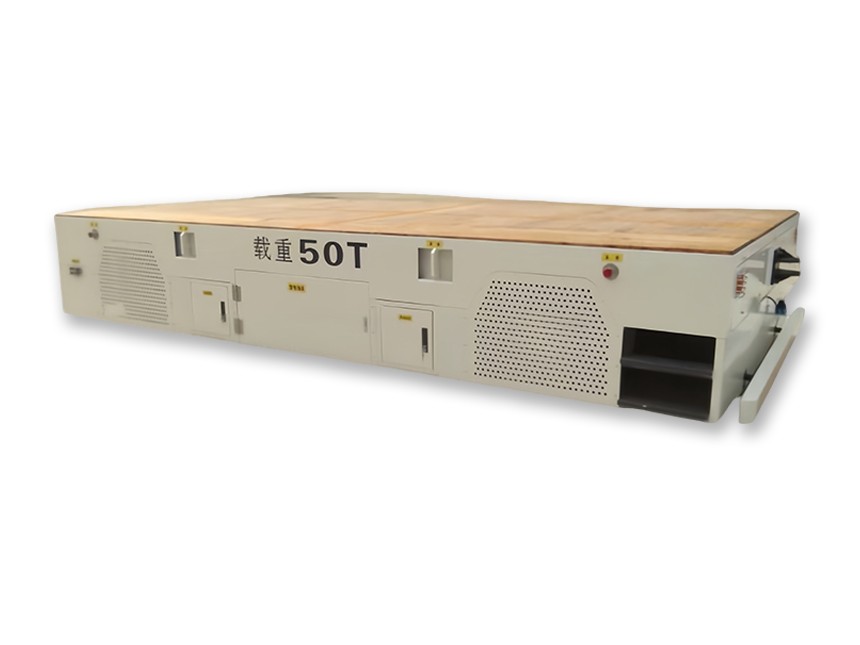
An electric transfer cart is a self-propelled unit that carries a load directly on its platform. The cart moves independently along routes determined by the operator or automated navigation system. Each cart operates as a standalone unit—its movement is independent of other carts, and multiple carts can operate simultaneously on different routes or even the same route when traffic management allows.
A tugger train, by contrast, uses a powered tractor unit that pulls multiple trailer carts in a linked configuration. The tractor moves along the route with all trailers following, creating a single transport unit that delivers multiple loads in one trip. Tugger trains are inherently batch transport systems—the amount of material transported per trip depends on how many trailers are attached and the total weight of the train.
Tugger trains excel in high-volume, fixed-route applications where the same materials move along the same path repeatedly throughout each shift. A single tugger train delivering materials to five stations along a route can complete five deliveries in one circuit, whereas five independent electric carts making the same deliveries require five separate trips. For high-frequency delivery routes with consistent load patterns, tugger trains offer superior throughput per operator.
Electric carts provide higher flexibility and often better throughput in variable-load, multi-destination operations. When delivery destinations change throughout the shift, when loads vary significantly in size and weight, or when different routes require different transport strategies, the independent operation of electric carts outperforms the fixed configuration constraints of tugger trains. Electric carts can be dispatched individually or in small groups to match exact load requirements, avoiding the wasted capacity of a fixed-configuration train.
Electric carts offer direct load capacity matching—you specify the cart capacity based on your actual load requirements, and each trip moves exactly the load the cart is rated for. This direct matching eliminates the tugger train problem of either underloading trailers (wasting capacity) or overloading the tractor (creating safety and equipment damage risks).
Tugger train capacity is limited by the tractor's towing capacity and the number of trailers that can be safely connected. Adding trailers increases delivery volume per trip but increases the train's turning radius, stopping distance, and overall complexity. Managing a train of six trailers in a facility with tight corners, frequent intersections, and pedestrian traffic requires highly skilled operators and creates substantial safety management requirements.
Tugger trains typically require wider aisles, larger turning radii, and more robust floor construction than electric carts to accommodate the longer train configuration and higher combined weight. The minimum aisle width for tugger train operation is typically 3.5-4.5 meters depending on trailer configuration, compared to 2.5-3 meters for a single electric cart. In facilities with space constraints, these infrastructure requirements may make tugger trains impractical.
Electric carts require less aisle space, navigate tighter corners, and impose lower point loads on floors because the load is distributed across fewer wheels on the self-propelled unit rather than spread across multiple trailer axle positions. For facilities with existing narrow aisle configurations, electric carts integrate without infrastructure modification.
Electric cart routes can be modified by simply changing the operator's route or updating an automated route program. Adding a new destination, rerouting around a temporary obstruction, or adjusting delivery sequences requires only programming changes—no physical infrastructure modification.
Tugger train routes are more difficult to modify because the longer train configuration may not fit new routes without major layout changes. The fixed infrastructure investment of designing facilities for tugger train operation becomes a constraint when operational requirements change—a new production line requiring different material flow patterns may be impossible to accommodate within a tugger train system designed for the previous operational model.
Tugger train maintenance involves both the tractor unit and all trailer carts, multiplying the maintenance complexity and parts inventory requirements. A tractor out of service takes down the entire train capacity; an electric cart out of service removes one unit from the fleet. Fleet management for tugger trains requires more maintenance capacity and spare equipment to maintain equivalent availability.
Electric carts have simpler mechanical configurations because each unit is self-contained and typically has fewer wearing parts than an equivalent-capacity tugger train system. The maintenance cost per transport unit over the equipment life is typically lower for electric cart fleets than for tugger train systems with equivalent capacity.
For operations with high-volume, fixed-route, consistent-load transport patterns and adequate aisle space, tugger trains deliver strong throughput and labor efficiency. For operations requiring route flexibility, variable load sizes, or navigation through space-constrained facilities, electric carts provide better operational fit. Many large facilities use both systems—tugger trains for main arterial high-volume routes and electric carts for flexible branch operations—leveraging each system's strengths where they apply.