+86 183 3953 1958
中文
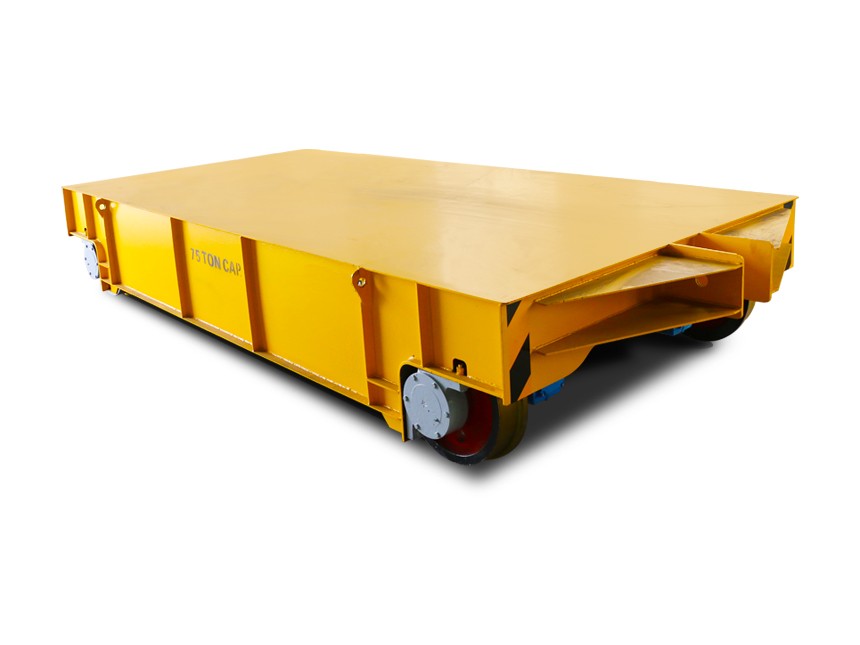
Rail-Guided Vehicles (RGVs) play a critical role in fixed-route manufacturing and assembly operations where materials must move along predefined paths between workstations. In such structured environments, consistency, accuracy, and coordination with production equipment are more important than route flexibility.
RGVs operate on dedicated rail tracks, ensuring repeatable movement, precise stopping, and predictable transport timing. This makes them especially suitable for assembly lines and production cells that rely on synchronized material delivery to maintain stable production rhythms.
Rail-Guided Vehicle systems are ideal for manufacturing operations that feature:
Fixed production layouts with clearly defined logistics routes
Sequential assembly or processing stations
High repeatability in material transfer tasks
Integration with robotic workstations or automated tools
Long-term production lines with minimal layout changes
Compared to free-navigation vehicles, RGVs provide lower system complexity and higher positional reliability in these applications.
Fixed-route production environments often struggle with timing mismatches, positioning errors, and inefficiencies caused by manual handling. Rail-Guided Vehicles effectively address these issues by:
Ensuring accurate docking at assembly and processing stations
Maintaining consistent delivery timing between stations
Reducing line stoppages caused by material delays
Supporting automation interfaces such as lifts, conveyors, and robots
Improving overall line stability and production efficiency
By acting as a predictable logistics carrier, RGVs help manufacturers maintain continuous and balanced assembly operations.
Fixed-route Rail-Guided Vehicle systems are widely used in:
Automotive and commercial vehicle assembly lines
Electrical equipment and control cabinet production
Home appliance and equipment assembly plants
Engine, gearbox, and transmission manufacturing
Automated machining and processing lines
In-plant logistics for serial production systems
Their modular design allows adaptation to various assembly workflows and station configurations.
| Parameter | Specification |
|---|---|
| Vehicle Type | Rail-Guided Vehicle (RGV) |
| Load Capacity | 2–40 tons (customizable) |
| Track Layout | Straight / Loop / Switch Track |
| Power Supply | Battery / Busbar / Cable |
| Control Method | PLC control with station logic |
| Positioning Method | Sensors / Encoder / RFID |
| Travel Speed | 0–40 m/min |
| Stop Accuracy | ±5 mm |
| Integration Capability | Conveyor, lift, robot interface |
| Safety Devices | Emergency stop, limit switches |
To support fixed-route manufacturing requirements, optional features include:
Automatic station docking and locking devices
Roller, chain, or customized workpiece carriers
Line-level communication with MES or PLC systems
Multi-vehicle scheduling and traffic management
Lift tables or transfer platforms
Visual and audible safety warning systems
These configurations enable seamless integration into automated assembly lines.