+86 183 3953 1958
中文
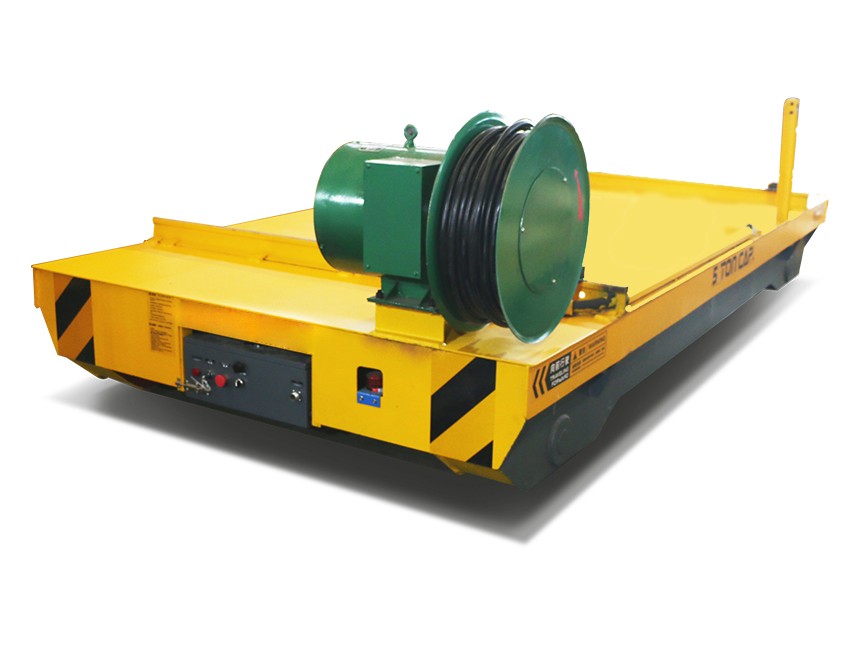
Rail-Guided Vehicles (RGVs) are engineered for high-precision, fixed-route material transfer in automated production environments where stability, repeatability, and system synchronization are critical.
Unlike free-navigation vehicles, RGVs operate on predefined rail tracks, ensuring predictable movement paths, accurate stopping positions, and consistent cycle times, making them especially suitable for continuous-flow manufacturing lines.
RGVs are commonly integrated into production lines to handle raw materials, semi-finished components, tooling fixtures, and heavy assemblies between workstations. Their rail-based guidance eliminates navigation deviation and minimizes positioning errors, which is essential for automated loading, robotic interfacing, and inline processing.
Rail-Guided Vehicles are particularly well-suited for environments with:
Fixed logistics routes and repetitive transport tasks
High-frequency, point-to-point material flow
Heavy or oversized loads requiring stable transport
Automated or semi-automated production lines
Strict requirements for positioning accuracy and safety
Typical production layouts include straight tracks, loop tracks, or switch tracks, allowing RGVs to adapt to different line configurations without changing the core control logic.
In many manufacturing facilities, traditional forklifts or manual carts introduce inefficiencies such as inconsistent cycle times, labor dependency, and safety risks. Rail-Guided Vehicles address these issues by:
Improving transport accuracy through rail-based guidance
Reducing labor involvement in repetitive internal logistics
Ensuring stable load handling for heavy or high-value components
Enhancing production rhythm by synchronizing with automated equipment
Lowering long-term maintenance costs compared to flexible navigation systems
By operating within a closed rail system, RGVs provide a reliable backbone for automated material flow.
Rail-Guided Vehicles are widely used across multiple industrial sectors, including:
Automotive manufacturing and assembly lines
Power equipment and electrical component production
Metallurgy and heavy fabrication workshops
Wind energy and large structural component plants
Automated warehouses and in-plant logistics systems
Cleanroom and controlled-environment manufacturing
Their modular design allows customization for load capacity, power supply, and control mode to match specific industry requirements.
| Parameter | Specification |
|---|---|
| Vehicle Type | Rail-Guided Vehicle (RGV) |
| Load Capacity | 1–50 tons (customizable) |
| Track Type | Straight / Loop / Switch Track |
| Power Supply Options | Battery Powered / Busbar Powered / Cable Powered |
| Drive System | AC Motor + Gear Reducer |
| Control Mode | Manual / Remote / Semi-Automated / Fully Automated |
| Traveling Speed | 0–40 m/min (adjustable) |
| Positioning Accuracy | ±5 mm |
| Operating Environment | Indoor industrial environments |
| Safety Features | Emergency stop, limit switches, overload protection |
To adapt to different production requirements, the following options are available:
PLC control system with HMI interface
Wireless remote control or integrated line control
Hydraulic lifting or scissor lift platform
V-shaped, roller, or customized load decks
Automatic docking and positioning sensors
Safety light curtains and audible warning systems
Explosion-proof or high-temperature components
All configurations can be customized to match specific production layouts and automation levels.