+86 183 3953 1958
中文
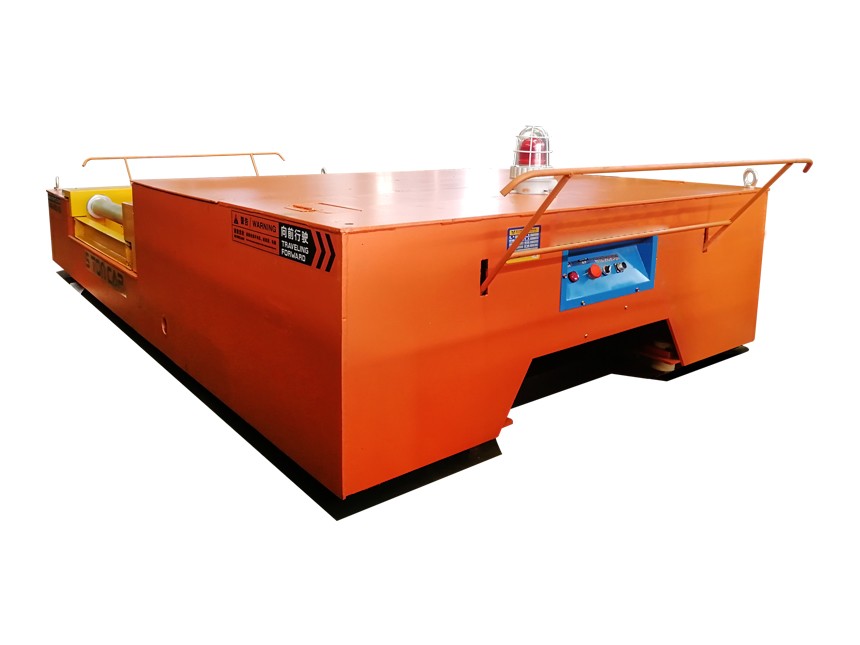
Rail-Guided Vehicles (RGVs) are designed to serve as core transport units in continuous industrial material handling systems. In production environments where materials must move frequently, continuously, and predictably between fixed stations, RGVs provide a highly efficient and controllable transport solution.
By operating on dedicated rail tracks, RGVs eliminate route uncertainty and traffic conflicts, enabling uninterrupted material flow that aligns closely with production takt time. This makes them particularly suitable for facilities pursuing lean manufacturing, automated production lines, and stable throughput optimization.
RGVs are especially effective in transport systems that require:
Continuous or cyclic material movement
Fixed transport routes with defined start and end points
High material flow density within limited plant space
Integration with conveyors, robots, and processing equipment
Long operating hours with minimal downtime
Compared with manual handling or flexible AGV systems, rail-guided solutions offer higher predictability and lower control complexity in structured layouts.
In continuous industrial transport scenarios, common challenges include material congestion, inconsistent delivery timing, and coordination difficulties between transport and processing equipment. Rail-Guided Vehicles address these issues by:
Maintaining consistent cycle times through rail-based movement
Reducing internal traffic interference by operating on exclusive tracks
Enhancing system throughput via synchronized multi-vehicle operation
Lowering energy consumption through optimized driving paths
Minimizing operator dependency in repetitive transport tasks
RGVs can operate individually or as part of a fleet, ensuring stable material supply without disrupting production rhythm.
Continuous transport RGV systems are widely used in:
Automotive body-in-white and final assembly lines
Engine, gearbox, and heavy component manufacturing
Steel structure and fabrication workshops
Automated storage and retrieval system (AS/RS) interfaces
Power equipment and transformer production lines
Industrial plants with long-distance in-plant logistics
Their scalability allows expansion of the transport system as production capacity increases.
| Parameter | Specification |
|---|---|
| Vehicle Type | Rail-Guided Vehicle (RGV) |
| Rated Load Capacity | 2–60 tons (customizable) |
| Track Configuration | Straight / Loop / Multi-Station |
| Power Supply | Battery / Busbar / Cable Reel |
| Drive Mode | Motorized rail drive |
| Control System | PLC-based centralized control |
| Maximum Speed | Up to 45 m/min |
| Stopping Accuracy | ±5 mm |
| Duty Cycle | Continuous operation |
| Safety System | Limit switches, emergency stop, collision protection |
To further improve transport efficiency, RGVs can be equipped with:
Automatic loading and unloading interfaces
Roller beds or chain conveyors on deck
RFID or barcode-based station identification
Multi-vehicle dispatch and traffic control system
Battery auto-charging or busbar power modules
Warning lights, sound alarms, and safety scanners
These options allow seamless integration into fully automated logistics systems.