+86 183 3953 1958
中文
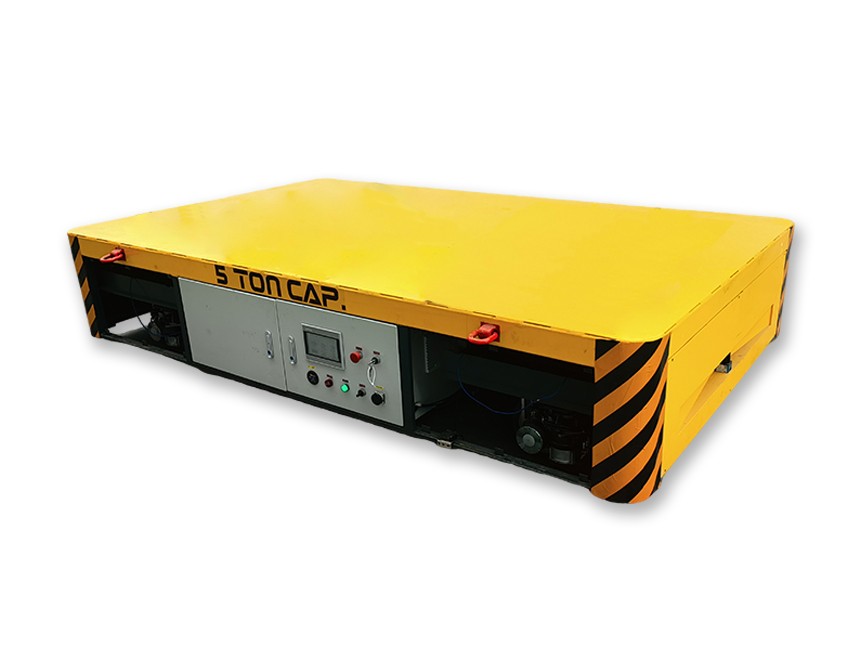
Walk into any modern factory and you'll see both. AGVs on programmed routes. Remote-controlled transfer carts moving loads on demand. Both do the same basic job — haul heavy materials from A to B. But the cost structure, implementation complexity, and operational fit are completely different.
The choice isn't about which technology is "better." It's about which one matches your scale, budget, and flexibility needs. Let's break it down without the marketing fluff.
A basic AGV starts around $30,000–$50,000 for light-duty work. Heavy-duty units with advanced navigation and fleet management can push $100,000+. And that's just the vehicle. You also need infrastructure — magnetic tape, QR codes, reflectors, or SLAM mapping. Plus control software, integration with your MES or WMS, and commissioning.
A remote-controlled electric transfer cart? $5,000–$20,000 depending on capacity and features. No infrastructure. No software licenses. No integration project. Charge the battery, train the operator, and it's working the same day.
For small and mid-sized factories, that's a hard gap to ignore. A fleet of five remote-controlled carts costs less than one AGV. The math speaks for itself.
AGVs shine in high-throughput, repetitive operations. Once programmed, they run 24/7 with minimal labor. In a battery factory or automotive plant with fixed routes and predictable schedules, labor savings pay back the higher investment in 3–5 years.
But operating costs include more than labor. AGVs need software updates, path re-mapping when layouts change, and specialized maintenance techs. Remote-controlled carts need an operator, but maintenance is straightforward mechanical work any factory technician can handle.
Here's a practical comparison for a mid-size manufacturing plant:
At 2,000 hours per year, the AGV saves roughly one full-time operator ($35,000–$50,000/year). Break-even is 2–3 years if the route is truly fixed and utilization is high. If routes change often or utilization drops below 60%, the payback stretches out — or never happens.
This is where remote-controlled carts win. Factory layouts change. Lines get reconfigured. New products need different material flows. An AGV route change means re-mapping, software updates, and often physical infrastructure mods. A remote-controlled cart just needs the operator to drive a different path.
For factories with frequent layout changes, mixed product lines, or seasonal variations, the flexibility of manual control outweighs the labor savings of automation. The cost of reconfiguring an AGV system — downtime, engineering time, infrastructure changes — can exceed the original installation cost over a few years.
AGVs work best where material flow is stable and predictable. Remote-controlled carts work best where adaptability matters.
AGVs can run continuously without breaks. In theory, that's higher efficiency. In practice, it depends on whether demand justifies continuous operation. An AGV running at 40% utilization because production is intermittent is wasting capital. A remote-controlled cart used only when needed has higher effective efficiency — you pay only for the transport you actually use.
Throughput calculations must include loading and unloading time, not just travel speed. An AGV moving at 1.5 m/s sounds fast, but if it waits 5 minutes at each end for manual loading, the effective cycle time isn't much better than a remote-controlled cart driven by an experienced operator.
In high-frequency, short-distance moves — say, feeding a line every 3 minutes — AGVs show their strength. The operator can't match the consistency. In longer, less frequent moves, the gap narrows.
AGV deployment is a project. Site survey, route planning, infrastructure installation, software configuration, testing, commissioning. Typical timeline: 2–6 months. During that time, affected areas may lose operational capacity.
Remote-controlled cart deployment is an event. Delivery, brief operator training, and operation. Timeline: a few days. No disruption to existing workflows.
For factories that can't afford production downtime, this matters. An AGV project that hits integration issues can delay go-live by weeks. Remote-controlled carts don't have integration issues — they don't integrate.
AGVs have more failure modes. Navigation sensors, software bugs, communication drops, fleet management conflicts. When an AGV fails, you often need vendor support or specialized technicians. Downtime can be hours or days.
Remote-controlled carts fail mechanically — wheels, bearings, batteries, motors. Fixable with standard tools and parts. Downtime is usually minutes or hours, not days. And there's no software to debug.
That said, a well-maintained AGV in a stable environment can hit 99%+ uptime. The reliability question is really whether your environment is stable enough for that to be realistic.
Adding AGVs means adding fleet management capacity, potentially expanding infrastructure, and reconfiguring traffic rules. It's not just buying another vehicle. Adding remote-controlled carts means buying another vehicle. That's it.
For operations scaling from 2 units to 20, AGVs make sense because fleet management and route optimization become valuable. For operations staying in the 1–5 unit range, the overhead of AGV fleet management isn't worth it.
Go with an AGV when:
Go with a remote-controlled cart when:
Some factories use both. AGVs for high-volume, fixed routes. Remote-controlled carts for variable, occasional, or project-specific moves. This hybrid approach maximizes the strengths of each while minimizing the weaknesses. The key is knowing which moves are truly predictable and which aren't.
AGVs and remote-controlled carts aren't competitors — they're tools for different jobs. The cost and efficiency comparison only makes sense in the context of your specific operation. High-volume, stable environments favor AGVs. Variable, flexible environments favor remote-controlled carts. Most factories, if they're honest about their material flow patterns, already know which camp they belong in.