+86 183 3953 1958
中文
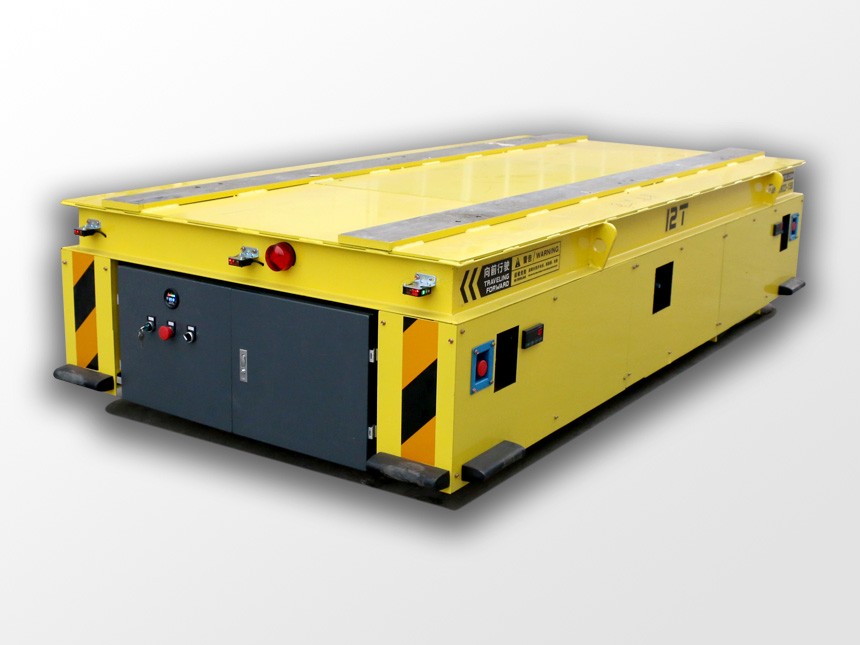
Most factories purchase transfer carts the same way they buy forklifts: compare load capacity, check the price, place the order. The problem is that electric transfer carts interact with your facility in ways a standard forklift never will. Floor conditions, travel distances, route complexity, and integration points all shape whether a seemingly adequate cart becomes a productivity asset or a daily bottleneck.
This guide provides a practical framework for matching transfer cart specifications to your actual workflow—not the idealized version in a project plan, but what happens on the floor every day.
Before opening a supplier catalog, document your material movement patterns in detail. Three questions reveal more than any spec sheet.
Go beyond weight. Document typical load dimensions, shape regularity, temperature, surface sensitivity, and whether loads are palletized or irregular. A cart that handles 5-ton steel coils needs very different deck reinforcement than one moving 5 tons of boxed components. For irregular loads, consider custom deck fixtures, roller tops, or lift tables integrated into the cart platform.
Map every pickup and drop-off point. Note aisle widths, door openings, floor transitions, and any ramps or slopes. A rail-guided cart may offer higher capacity for straight-line routes, but a single curve or floor obstacle can make a rail-less cart the better choice. Measure the narrowest point on every route—not the average width.
Count round trips per shift and average trip duration. A cart completing 50 short trips per shift needs a very different battery profile than one making 5 long hauls. Include peak periods—the 2-hour rush when three production lines all need material simultaneously—because that's when undersized batteries or insufficient charging infrastructure reveal themselves.
The nameplate load capacity tells only part of the story. What matters in daily operation is the cart's ability to handle your specific load geometry and distribution.
A 10-ton rated cart with a solid steel deck handles distributed loads differently than one with a frame-only deck. Concentrated point loads—such as a die set resting on four small feet—create localized stress that can deform decks and damage wheels over time. If your loads aren't evenly distributed, specify the maximum point load rather than total weight, and confirm the deck construction supports it.
Placing a heavy load onto a cart creates momentary forces 1.5–2× the static weight. Carts that load via overhead crane or forklift require reinforced decks and shock-absorbing wheel assemblies. Carts that are loaded gradually from roller conveyors experience lower impact but need precise height alignment.
Three dominant navigation approaches exist, each suited to different operational profiles.
Embedded or surface-mounted rails provide the highest load capacity and positioning accuracy. Ideal for fixed routes with loads exceeding 20 tons. Limitations: route flexibility is zero, and rail installation costs $150–400 per linear meter depending on floor preparation. Best for dedicated production lines where the material flow never changes.
Magnetic tape guidance offers semi-fixed routing at lower infrastructure cost. Tape can be repositioned in hours rather than days. Load capacity typically tops out at 20 tons. The trade-off: tape wears in high-traffic areas and requires periodic replacement, and surface debris can interfere with sensor reading.
Operator-controlled carts with no fixed guidance provide maximum flexibility. Navigation relies on the operator's judgment with assistive features like obstacle detection and speed control. Best for facilities with variable routes, frequent layout changes, or mixed-use aisles shared with forklifts and pedestrians.
Control systems look straightforward in demos. In practice, operator acceptance determines whether a cart gets used properly—or at all.
Wired pendants are reliable and inexpensive but chain the operator to the cart. For loads over 3 tons where operators should maintain safe distance, radio remote control is the minimum. Dual-mode systems that support both pendant and radio give operators flexibility while providing a backup if the remote battery dies mid-shift.
Carts moving unloaded can travel faster; carts carrying fragile or unstable loads need slower, smoother acceleration. Look for control systems that support multiple speed profiles selectable by the operator, with automatic speed reduction when obstacle sensors detect nearby objects.
Facility conditions degrade cart performance in ways catalog photos never show.
Rough concrete, expansion joints, and floor gradients above 3% stress drive motors and reduce battery range. Polyurethane wheels handle smooth epoxy floors well but wear rapidly on rough concrete. For abrasive floors, specify solid rubber or cast iron wheels and verify motor power ratings include a grade-climbing margin of 15–20%.
Standard lithium batteries operate optimally at 15–35°C. Foundries, cold storage, and outdoor yard applications need batteries rated for the actual temperature range. In dusty, wet, or corrosive environments, specify sealed electrical enclosures (IP65 minimum) and corrosion-resistant fasteners on all exposed surfaces.
The gap between specification sheets and real-world performance closes only with on-site testing. Three tests that reveal more than any brochure:
Transfer cart selection is not about finding the most capable machine; it's about finding the one that fits your workflow so seamlessly that operators prefer it over the manual alternatives. Document your real-world movement patterns first, apply specifications second, and validate with on-site testing before signing. The right match pays for itself in one shift; the wrong one costs you every shift thereafter.