+86 183 3953 1958
中文
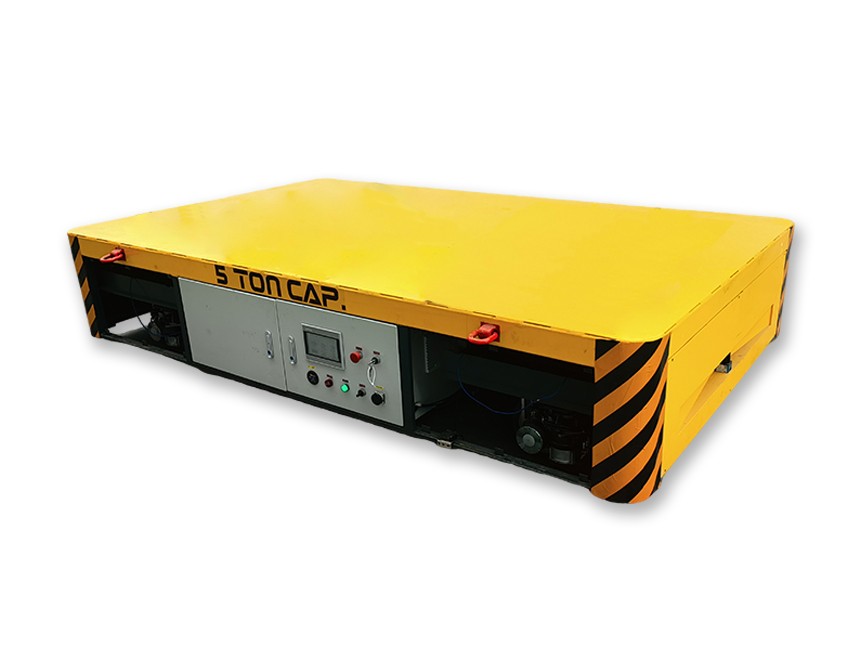
Choosing the right motor for a heavy duty transfer cart isn't just about power. It's about matching the drive system to real-world loads, floor conditions, and duty cycles. Get it wrong, and you'll face overheating, premature wear, or carts that simply can't move their rated load. Here's what actually matters when specifying motors for industrial flatbed carts.
Start with the basics. A transfer cart motor must overcome static friction, rolling resistance, and any incline in the travel path. For a 10-ton cart on steel wheels and rail, rolling resistance might be 0.5% to 1% of the load weight. Add acceleration torque, and your motor needs headroom.
Most engineers size motors based on steady-state travel speed. That's a mistake. The real test is starting torque — especially when the cart sits idle overnight or carries unevenly distributed loads. A motor with 1.5x to 2x the calculated running torque is usually the safe bet for heavy duty applications.
Three motor types dominate the industrial cart market:
DC brushless motors — Popular for battery-powered carts. They offer good torque at low speeds, simple speed control, and decent efficiency. Maintenance is minimal since there's no brush wear. The downside? Controllers add cost, and high-power models get expensive.
AC induction motors — Rugged, proven, and cost-effective for cable-powered or rail-powered carts. They handle continuous duty well and don't mind dusty environments. Variable frequency drives (VFDs) give you smooth speed control. The catch: they're heavier and less efficient at partial loads.
DC brushed motors — Still common in budget carts and replacement parts. Simple, cheap, and easy to troubleshoot. But brushes wear out, and they're less efficient than brushless designs. Fine for light-duty or intermittent use. Not ideal for 24/7 production lines.
Here's a rough formula that works in practice:
Power (kW) = (Total Weight × Rolling Resistance × Speed) / (6120 × Efficiency)
For a 20,000 kg cart, 0.8% rolling resistance, 1.2 m/s speed, and 85% drivetrain efficiency, you're looking at roughly 3.7 kW running power. Add 50% for acceleration and gradients, and spec a 5.5 kW motor. It's not exact, but it gets you in the right ballpark for quoting and preliminary design.
Of course, real-world conditions vary. Rough floors, rail joints, and wheel alignment issues all increase resistance. If your cart travels outdoors or across expansion gaps, bump the safety factor higher.
Motors rarely drive wheels directly. Most transfer carts use gear reducers to match motor speed to wheel RPM. Typical ratios range from 20:1 to 60:1 depending on wheel diameter and travel speed.
Wheel drive layout matters too. Single-wheel drive is simple but can cause tracking issues on long carts. Dual-wheel drive (one motor per wheel) improves traction and reduces rail wear, but doubles your motor and controller cost. For very heavy loads or poor traction conditions, dual drive is usually worth it.
Some designs use a central drive with a chain or shaft coupling to both wheels. This gives synchronized drive without duplicating motors. The trade-off is mechanical complexity and potential backlash.
Motors for industrial carts live in tough conditions. Dust, moisture, temperature swings, and vibration are normal. IP54 or IP55 protection is the minimum for indoor use. Outdoor or washdown environments need IP65 or better.
Duty cycle affects motor sizing more than most people realize. A cart that runs 10 minutes per hour can use a smaller motor than one running continuously. But don't guess — measure actual cycle times. If your cart moves 200 times per shift with 30-second trips, that's different from a cart moving once per hour for 10 minutes.
Thermal management is another overlooked factor. Battery-powered carts have limited space for motor cooling. A motor that runs hot in summer conditions will degrade faster and draw more power from the battery. If possible, spec motors with built-in thermal protection or temperature sensors.
Modern transfer carts need more than on/off control. Variable speed, smooth acceleration, and regenerative braking all extend motor life and improve safety. VFDs for AC motors and PWM controllers for DC motors give you this flexibility.
Safety systems should integrate with motor control. Emergency stops must cut power immediately. Soft-start ramps prevent mechanical shock. Limit switches and collision sensors need fast motor response — typically under 0.5 seconds from trigger to full stop.
For remote-controlled carts, motor response time affects operator confidence. Laggy acceleration or jerky stops make precise positioning difficult. Test controller-motor pairing before finalizing a design, especially for wireless systems.
Even the best motors need maintenance. Brushed motors need brush inspection every 500–1000 hours. Gearboxes need oil changes. Bearings eventually wear out. Plan access for these tasks when designing the cart layout.
Standardization pays off here. Using the same motor model across your cart fleet simplifies spare parts inventory and technician training. If you run 20 carts, keeping one or two spare motors on the shelf beats waiting weeks for a replacement.
Track motor operating hours and temperature trends if possible. Predictive maintenance — replacing a motor before it fails — avoids unplanned downtime. Some modern controllers log this data automatically.
Here's what to verify before finalizing motor specs:
• Calculate running torque and acceleration torque separately
• Add 50–100% safety factor for real-world conditions
• Match motor type to power source (battery, cable, rail)
• Verify IP rating for the operating environment
• Confirm duty cycle and thermal requirements
• Plan gear ratio for target speed and wheel diameter
• Check controller compatibility and response time
• Ensure maintenance access and spare parts availability
Motor selection for heavy duty transfer carts is part engineering calculation, part practical judgment. The formulas get you close, but floor conditions, duty cycles, and environmental factors determine whether your cart performs reliably for years or becomes a maintenance headache. Size conservatively, choose proven motor types, and always leave margin for the conditions you can't perfectly predict.