+86 183 3953 1958
中文
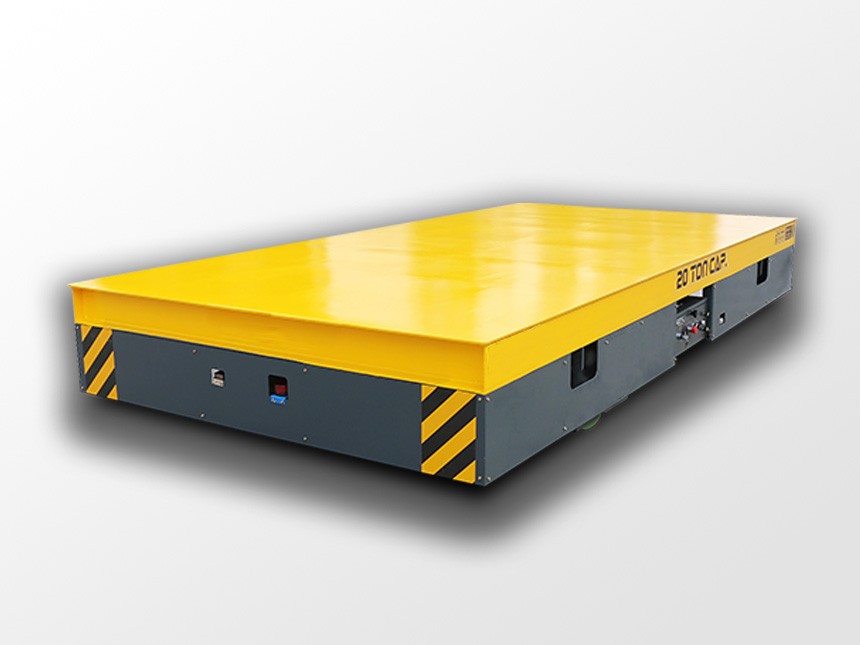
A remote-controlled transfer cart is a motorized platform that moves heavy loads across factory floors without a fixed rail or driver on board. Instead of following a magnetic tape or laser guide, an operator controls it from a distance — usually with a handheld radio transmitter. These carts fill a gap between fully automated AGVs and manual forklifts. They're flexible enough to go anywhere the floor allows, yet powerful enough to haul tens of tons.
The basic idea is straightforward: electric motors drive the wheels, a battery pack supplies power, and a radio receiver translates button presses into motion commands. But the engineering behind reliable remote control in an industrial environment is more involved than it looks. Interference, safety, and precise maneuvering all need to be solved.
Most industrial remote-controlled carts use radio frequency (RF) communication in the 2.4 GHz or 433 MHz bands. The 2.4 GHz band is crowded — Wi-Fi, Bluetooth, and other devices share it — so good systems use frequency-hopping spread spectrum (FHSS) to avoid interference. This means the transmitter and receiver jump between frequencies dozens of times per second, making it unlikely that a stray signal blocks the command.
The transmitter is typically a pistol-grip or pendant-style remote with push buttons or a joystick. Each button sends a coded signal. The receiver on the cart decodes it and passes it to the motor controller. Modern systems use digital encoding with unique IDs, so your cart won't respond to a neighbor's remote — or to a random signal from a nearby welding machine.
Range varies. In open factory spaces, 100 meters is typical. Through walls or metal structures, it drops. Some systems offer relay antennas to extend coverage. For critical applications, dual-receiver setups provide redundancy — if one receiver loses signal, the other takes over.
When the operator presses "forward," the receiver sends a low-voltage signal to the motor controller. The controller ramps up power to the drive motors — usually brushless DC or AC induction motors. The ramp-up matters. A sudden jolt at full torque would damage the load and the mechanical components, so controllers use soft-start algorithms to accelerate smoothly.
Steering depends on the wheel configuration. Common setups include:
Differential drive: Two motors, one per wheel. Speed differences between left and right wheels turn the cart. Simple, reliable, but wears tires during tight turns.
Four-wheel drive with steering: All wheels drive, front or rear wheels steer mechanically or electrically. Better for heavy loads and tight spaces, but more complex.
Omnidirectional wheels: Mecanum or omni wheels allow sideways movement. Expensive and maintenance-intensive, but unbeatable for maneuvering in cramped workshops.
Braking is usually regenerative — the motor acts as a generator to slow the cart — plus spring-applied electromagnetic brakes that engage when power is cut. This failsafe means the cart stops if signal is lost, battery dies, or emergency stop is pressed.
Remote control introduces risk: an operator might not see the cart's full path, or the signal might drop at the wrong moment. Safety systems are layered to catch these scenarios.
Emergency stop: Hardwired, not software-based. Pressing the E-stop on the remote or a button on the cart itself cuts power to the motor contactors immediately. The cart coasts to a stop with brakes applied.
Collision avoidance: Many carts carry ultrasonic or laser sensors that detect obstacles in the path. If something enters the safety zone, the cart slows or stops automatically — even if the operator is still pressing "forward."
Signal loss protection: If the cart loses radio contact for more than a preset time (usually 0.5–2 seconds), it stops automatically. This prevents runaway carts if the operator walks out of range or the remote battery dies.
Speed limiting: Some systems allow different speed profiles — slow for tight spaces, faster for long straight runs. This is often configured in the controller, not left to operator discretion.
Audible and visual warnings: Flashing lights and beepers alert nearby workers when the cart is moving. In noisy factories, this is essential.
Remote-controlled carts are almost always battery-powered — trailing cables defeat the purpose of flexible movement. Lead-acid batteries are still common for cost reasons, but lithium iron phosphate (LiFePO4) is taking over. Lithium batteries charge faster, last longer, and don't need watering. For a cart that might run multiple shifts, opportunity charging (topping up during breaks) keeps it in service without long downtime.
Battery capacity sizing depends on duty cycle: how far the cart travels, how often it starts and stops (acceleration is energy-intensive), and how much slope it climbs. A typical 10-ton cart with a 5 km/h top speed and 8-hour shift might need 200–400 Ah at 48V. Undersizing the battery leads to mid-shift shutdowns. Oversizing adds weight and cost.
The battery management system (BMS) monitors cell temperatures and voltages. In cold environments, heated battery packs prevent capacity loss. In hot environments, thermal management prevents degradation. These aren't luxuries — they're what let the cart work reliably year-round.
A typical shift with a remote-controlled cart looks like this:
Pre-shift check: Operator inspects wheels, battery level, brakes, and emergency stop function. Most facilities require a signed checklist.
Load attachment: The load is placed on the cart, either by crane, forklift, or directly if the cart has a built-in lifting platform. The operator verifies load centering and securing.
Movement: Operator stands at a vantage point with clear sight lines, or follows the cart at a safe distance. Commands are sent via remote. The cart responds in real time, with a slight delay (typically under 100 ms) that operators quickly adapt to.
Positioning: For precise placement — say, aligning with a machine tool or conveyor — the operator uses inching mode (slow, pulse-by-pulse movement) or switches to a secondary, more precise control channel. Some systems offer automatic positioning aids, like laser line projectors that show the cart's centerline.
Unloading and return: Once the load is transferred, the cart returns to its staging area or proceeds to the next task. Battery charging happens during breaks or at shift end.
Remote-controlled carts aren't the answer for every application. They shine where:
The route changes frequently and doesn't justify fixed infrastructure like rails or magnetic tape.
Loads are too heavy or awkward for forklifts.
The environment is hazardous for human drivers (high heat, fumes, narrow spaces).
Multiple carts share space and need human judgment to coordinate.
Full AGV automation is too expensive or complex for the current operation.
They're less ideal where the same route runs thousands of times per day — that's where rail-guided carts or AGVs earn their keep through consistency and lower labor cost.
Remote-controlled transfer carts work by combining reliable radio communication, robust electric drive systems, and layered safety protections. The operator provides judgment and flexibility; the machine provides power and precision. For factories that need heavy material movement without the rigidity of fixed-path systems, they're a practical middle ground. The key to success is matching the control system, drive configuration, and safety features to your actual environment and workflow — not just buying the cart with the highest load rating.