+86 183 3953 1958
中文
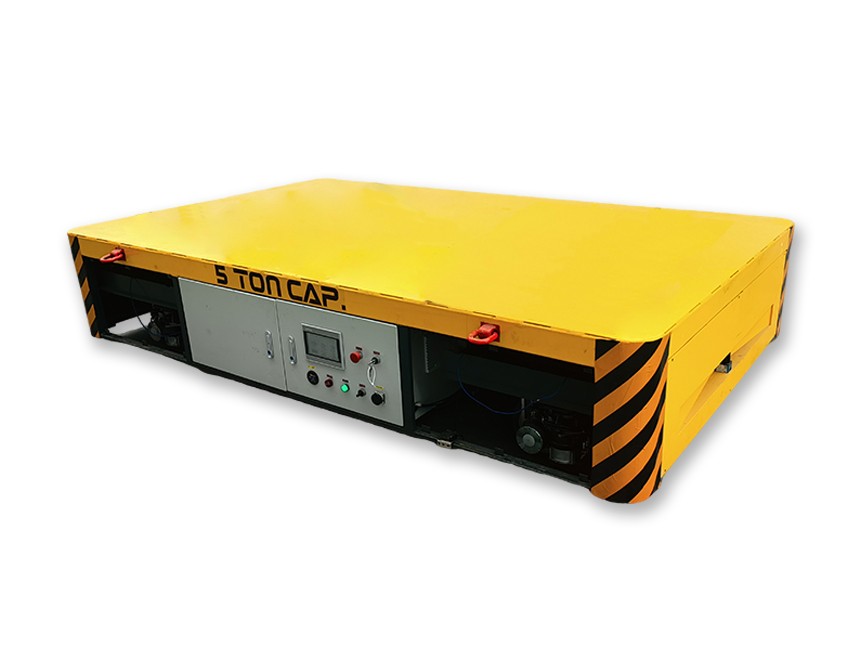
Selecting a transfer cart for your facility sounds straightforward—find one that moves your loads, right? But when production schedules hinge on reliable material transport, and safety regulations hold you accountable for every overload incident, "it seemed fine at the time" is not a viable defense. Load capacity is not a specification you negotiate; it is a constraint you respect.
This guide walks you through how load capacity is defined, calculated, and applied in real AGV transfer cart selection—so you can spec the right unit for your application the first time.
Rated load capacity is the maximum payload a transfer cart is certified to carry under specified conditions—typically on a flat, level surface, at a defined travel speed, within a nominal operating temperature range. This is not a suggestion. It is a design limit derived from structural analysis, wheel load ratings, motor torque margins, and safety factor calculations.
Key distinction: the cart's self-weight plus its payload must not exceed the combined axle load rating of the floor or rail system it operates on. A 5-ton-rated cart with a 2-ton self-weight carries a 3-ton payload—not 5 tons on top of its own mass.
Never select a cart based on your nominal load alone. Account for:
Example: if your heaviest single trip payload is 8 metric tons including dynamic factors, select a cart rated for a minimum of 10 tons.
A cart rated for 10 tons assumes a specific wheel load distribution and a floor capable of supporting it. Key factors:
If your floor capacity is 8 tons/m² and your cart's wheel contact pressure exceeds that, you need either a different wheel configuration or floor reinforcement.
The method a transfer cart uses to navigate affects how predictably it handles loads:
For high-load applications (5 tons+), fixed-path systems often offer better long-term reliability because navigation behavior under load is more deterministic.
Run time and charge frequency are load-dependent. At rated load:
Load capacity does not exist in isolation. Evaluate how the transfer cart integrates with:
| Rated Capacity | Typical Application | Recommended Navigation | Battery Type |
|---|---|---|---|
| 500 kg – 2 ton | Small parts, toolkit transport, light assembly | Laser/visual SLAM | Lithium-ion (24V) |
| 2 – 5 ton | Standard pallets, moderate container transport | Fixed path or hybrid | Lithium-ion (48V) |
| 5 – 20 ton | Heavy pallets, steel coils, machinery | Fixed path (rail/inductive) | Lithium-ion (72V+) |
| 20+ ton | Steel slabs, large castings, aerospace components | Fixed path, specialized bogie design | Dual lithium packs |
Follow this decision sequence:
Load capacity is the non-negotiable starting point for transfer cart selection. Spec it accurately, apply a safety margin, verify your floor's limits, and confirm that the battery and navigation systems are qualified for that load—not just at no-load test conditions. Get those fundamentals right, and the rest of your system integration falls into place with far less friction.
Need a load capacity assessment for your specific application? Provide your peak payload, floor conditions, and workflow requirements, and our engineering team can recommend the right AGV transfer cart configuration—typically within 24 hours.