How to Improve Workshop Transport Efficiency
How to Improve Workshop Transport Efficiency
Workshop transport is where production plans meet reality. A well-designed material flow keeps operators working and machines fed. Poor transport creates idle time, bottlenecks, and frustration. After working with hundreds of facilities, we've identified the patterns that separate efficient workshops from those constantly fighting their own logistics.
Map the Current State
You can't improve what you haven't measured. Start with a spaghetti diagram — trace every material movement for a week:
- Where does each component originate?
- What path does it take to reach the workstation?
- How long does it wait at each staging point?
- Who moves it, and with what equipment?
- Where do backtracking and crossing paths occur?
Most workshops discover that 30-40% of material travel distance is unnecessary. Crossed paths, redundant staging, and poor layout create waste that no amount of speed can fix.
Eliminate Unnecessary Movement
Once you see the waste, eliminate it:
- Co-locate suppliers and consumers: If Station B uses Station A's output, put them adjacent
- Consolidate storage: Multiple small stock locations create travel. Centralize where possible
- Deliver to point of use: Don't drop materials at a central location for operators to fetch
- Standardize containers: Mixed container sizes require handling adjustments and don't stack efficiently
- Remove obstacles: Every pillar, unused machine, and storage pile forces detours
The goal is straight-line flow. Every turn, every backtrack, every elevator ride adds time and risk.
Right-Size Your Transport Equipment
Too big wastes space and energy. Too small requires multiple trips. Match equipment to actual loads:
- Small parts (under 50kg): Hand trucks, rolling carts, or gravity conveyors
- Medium loads (50-500kg): Platform trucks, electric carts, or tugger trains
- Heavy items (500kg-10 tons): Electric transfer carts, overhead cranes, or forklifts
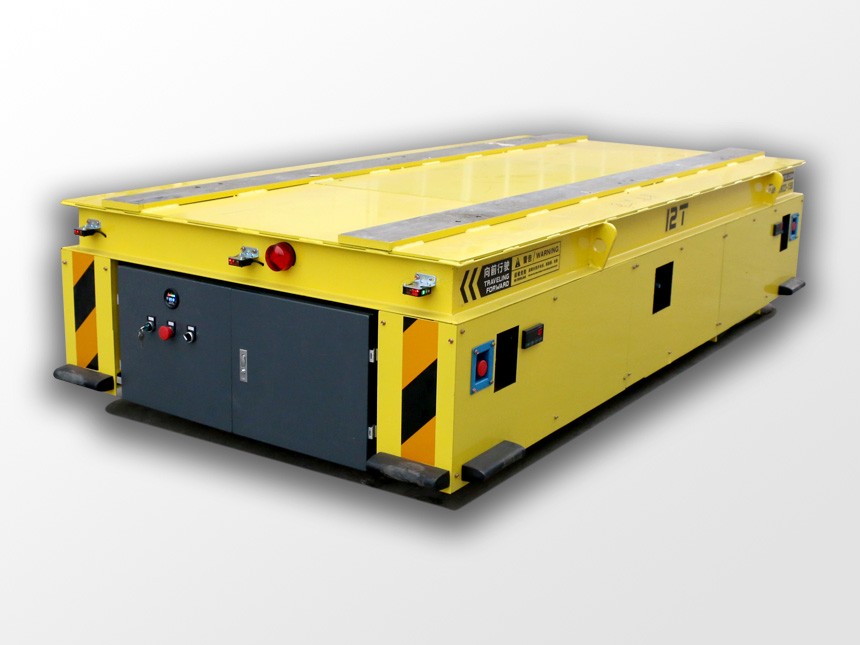
- Very heavy (10+ tons): Rail-guided transfer carts or specialized heavy haulers
Using a forklift to move 100kg boxes is like using a sledgehammer for finish carpentry. It works, but it's inefficient and dangerous.
Implement Pull Systems
Push systems (production pushes material forward regardless of downstream need) create overproduction and congestion. Pull systems (downstream stations signal when they need material) right-size the flow:
- Kanban cards: Physical signals that trigger replenishment when inventory drops
- Electronic signals: Andon lights or MES messages that alert material handlers
- Supermarket systems: Small buffer stock at consumption points, replenished from central stores
- Just-in-time delivery: Material arrives minutes before need, not hours
Pull systems reduce work-in-process inventory by 50-70% and eliminate the scramble to find floor space for excess material.
Optimize Transport Timing
When you move matters as much as how:
- Scheduled milk runs: Regular routes that hit every station on a predictable cycle
- Off-peak delivery: Move bulk materials during breaks or shift changes
- Synchronized with production: Deliver components when the previous batch is nearly consumed
- Eliminate rush trips: Rush means someone upstream failed to plan. Fix the planning, not the transport
Train Operators in Material Handling
Efficient transport requires skill, not just equipment:
- Proper loading technique — center weight, secure loads, respect capacity
- Route optimization — shortest path, designated lanes, avoiding congestion
- Equipment care — pre-operation checks, charging discipline, damage reporting
- Safety awareness — pedestrian zones, speed limits, right-of-way rules
Untrained operators take longer routes, overload equipment, and create safety incidents that shut down entire areas.
Use Technology Where It Helps
Not every workshop needs automation, but some technologies deliver clear ROI:
- AGVs for repetitive routes: Automated carts handle predictable A-to-B moves, freeing people for complex tasks
- WMS integration: Warehouse management systems direct put-away and picking, eliminating search time
- Real-time location: Track high-value items so time isn't wasted searching
- Digital work instructions: Show operators exactly what to move, where, and when
Start simple. A $50 whiteboard with route schedules often outperforms an unconfigured $50,000 software system.
Measure and Iterate
Track the metrics that matter:
- Material travel distance per unit produced
- Transport time as percentage of total cycle time
- Equipment utilization (carts idle vs. moving)
- Damage rate from handling
- Operator feedback on flow problems
Review weekly. Small adjustments compound into major improvements over months.
Conclusion
Workshop transport efficiency isn't about buying the fastest carts or the most expensive software. It's about understanding your actual material flow, eliminating waste, right-sizing equipment, implementing pull systems, and building operator skill. The workshops that master these fundamentals move more material with less effort — and their operators spend their time adding value, not fighting logistics.